
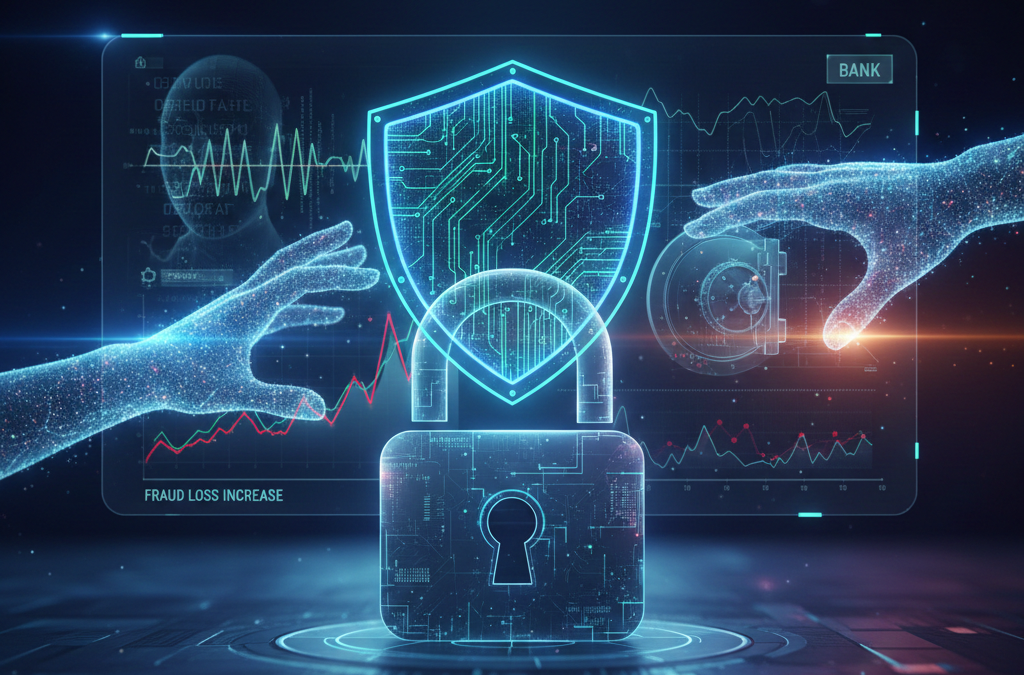
Cyber-Secure Finances: Protecting Your Business Banking in an Age of AI Fraud
In 2026, the “standard” phishing email, the one with the broken English and the suspicious link, is a relic of the past. Today’s fraudsters are using Agentic AI and Deepfake technology to launch attacks that are not just automated but hyper-personalized and alarmingly convincing.
According to recent Experian reports, more than 60% of companies have experienced higher fraud losses over the past year. As bad actors become more sophisticated, your business’s financial defenses must evolve. Here is how to shield your business banking from the next generation of AI-driven threats.
The New Threat Landscape: Beyond Phishing
Fraud has moved from “spray and pray” to “precision targeting.” Understanding how AI is weaponized is the first step in defense.
Deepfake Voice & Video: Fraudsters can now clone the voice of your CEO or a trusted vendor using just a 30-second audio clip. They may call your finance team requesting an “urgent” wire transfer that sounds exactly like a legitimate request.
AI-Enhanced Business Email Compromise (BEC): AI tools analyze your company’s public communications to mimic your tone and style perfectly, making “spoofed” invoices nearly indistinguishable from real ones.
Agentic AI Bots: These are autonomous bots that can engage in long-term “social engineering,” building trust with your employees over weeks before finally asking for sensitive credentials.
Implement “Human-in-the-Loop” Verification
Technology alone isn’t enough; you need a culture of healthy skepticism.
The Multi-Channel Rule: Never authorize a significant wire transfer or change in payment details based on a single communication channel (like an email). Establish a policy requiring secondary confirmation via a known, trusted phone number.
Internal Safewords: For high-level executives, some businesses are adopting internal “safewords” or phrases that must be used during verbal requests for sensitive actions to verify that the person on the other end isn’t a deepfake.
Upgrade to Behavioral Biometrics
Traditional passwords and even standard SMS-based two-factor authentication (2FA) are increasingly vulnerable to AI-powered “Man-in-the-Middle” attacks.
Continuous Authentication: Modern business banking platforms now use AI to monitor “behavioral biometrics”—things like how you move your mouse, your typing cadence, and your typical login locations.
Push-to-Verify: Move away from SMS codes, which can be intercepted. Use app-based push notifications that are cryptographically bound to a specific, physical device.
Audit Your “Agentic” Footprint
As businesses begin using AI agents to handle routine tasks like bill pay and reconciliation, they create new entry points for hackers.
Limit AI Permissions: If you use AI tools for your finances, ensure they have “read-only” access whenever possible. Never give an AI agent the independent authority to move funds without final human approval.
Vendor Due Diligence: Ask your banking partners and software providers specifically how they are defending against Adversarial AI (attacks designed to trick their own security algorithms).
Regular “Red Team” Drills
The best way to know if your team is ready is to test them.
Pro-Tip: Run AI-specific phishing simulations. Use modern tools to send out “AI-style” phishing emails to your staff. These simulations shouldn’t be about punishment, but about training the “muscle memory” needed to spot subtle anomalies.
In 2026, cybersecurity is no longer just an IT issue; it is a core financial competency. By combining advanced behavioral technology with rigorous internal protocols, you can ensure your business stays a hard target in an age of automated fraud.
“We’ve confidently referred businesses to them, and the feedback has been unanimously positive.”
– Mike Doherty: Founder, Understanding eCommerce.
Follow us on LinkedIn – Zumifi.