
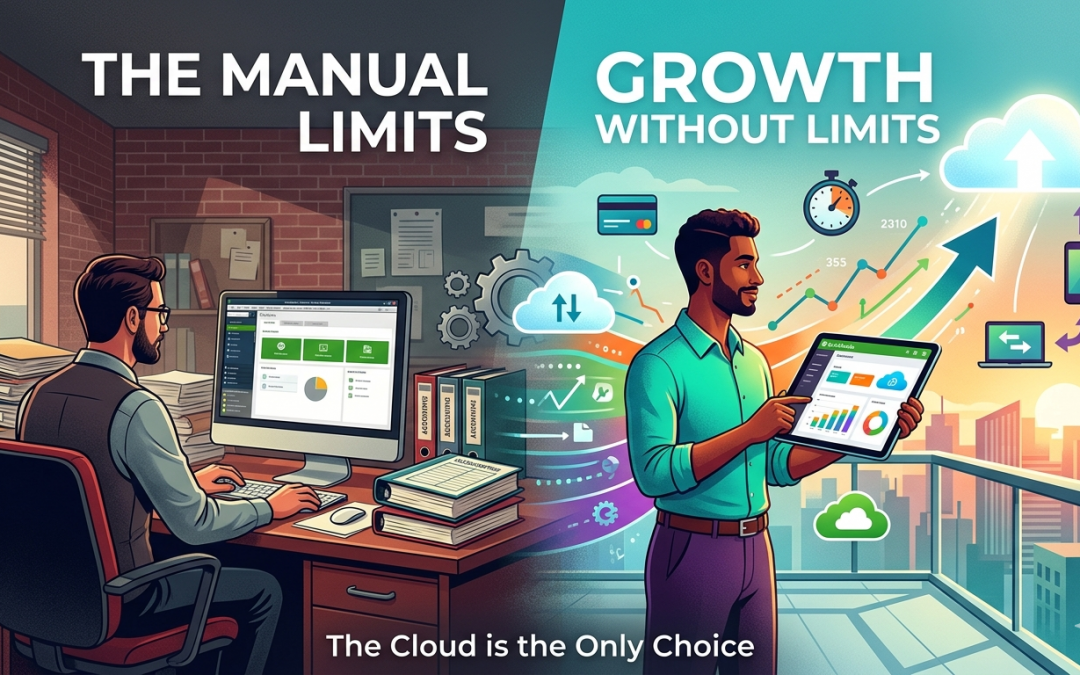
QuickBooks Online vs. Desktop: Why the Cloud is the Only Choice for Growth
For years, the choice between QuickBooks Desktop and QuickBooks Online (QBO) was a matter of personal preference or specific industry niche. However, as the pace of business accelerates and the need for real-time data becomes non-negotiable, the scales have tipped decisively.
For businesses looking to scale, the “Desktop vs. Online” debate is effectively over. The cloud isn’t just a different way to host your books; it is a fundamental shift in how financial data is leveraged to drive growth.
Real-Time Financial Visibility
The primary limitation of Desktop software is its static nature. Data is only as current as the last manual entry or bank download. In a growth phase, waiting until the end of the month to see your cash flow position is a liability.QuickBooks Online provides a live financial dashboard. With automated bank feeds that refresh daily, you can monitor margins, track expenses, and view your cash position in real-time. This allows for agile decision-making, whether that is green-lighting a new project or tightening the belt on overhead before a shortfall occurs.
Seamless Collaboration and Accessibility
Growth often requires moving beyond a single office or a single bookkeeper. QuickBooks Desktop relies on “company files” that must be shared, backed up, and version-controlled. This creates bottlenecks and the risk of data corruption.
The cloud eliminates these barriers:
- Multi-User Access: Your CPA, bookkeeper, and internal team can work simultaneously in the same file from different locations.
- Mobile Functionality: Capture receipts on the go, send invoices immediately after a client meeting, and check your P&L from your phone.
- No Manual Backups: QBO handles data security and backups automatically, ensuring your financial history is protected without manual intervention.
The Power of the Ecosystem
Perhaps the greatest advantage of the cloud is its ability to “talk” to other software. QuickBooks Online serves as the hub for a massive ecosystem of third-party applications.
Modern businesses can automate nearly every facet of their financial workflow by integrating QBO with:
- Project Management: Syncing job costs and labor hours.
- Payment Processing: Allowing clients to pay invoices via credit card or ACH for faster AR cycles.
- Inventory & CRM: Ensuring sales data and stock levels flow directly into your ledger.
These integrations reduce manual data entry, which is the leading cause of accounting errors and a major drain on staff productivity during periods of expansion.
Scalability Without the IT Overhead
QuickBooks Desktop requires hardware maintenance, server space, and manual software updates. As your business grows, these costs grow with it.
With QBO, the infrastructure is managed by Intuit. You receive automatic updates, new features, and security patches without lifting a finger. This allows your team to focus on high-level strategy and community engagement rather than managing software versions and server compatibility.
QuickBooks Desktop remains a robust tool for businesses with very specific, complex inventory needs or limited internet access, but it is increasingly becoming a legacy product. For the modern entrepreneur, the cloud offers transparency, automation, and flexibility that Desktop simply cannot match. If growth is the goal, your financial foundation must be in the cloud.
Contact us today or call 415.550.3070 to learn more about our experience and expertise, and how you can benefit from customized bookkeeping services tailored to your business needs.