
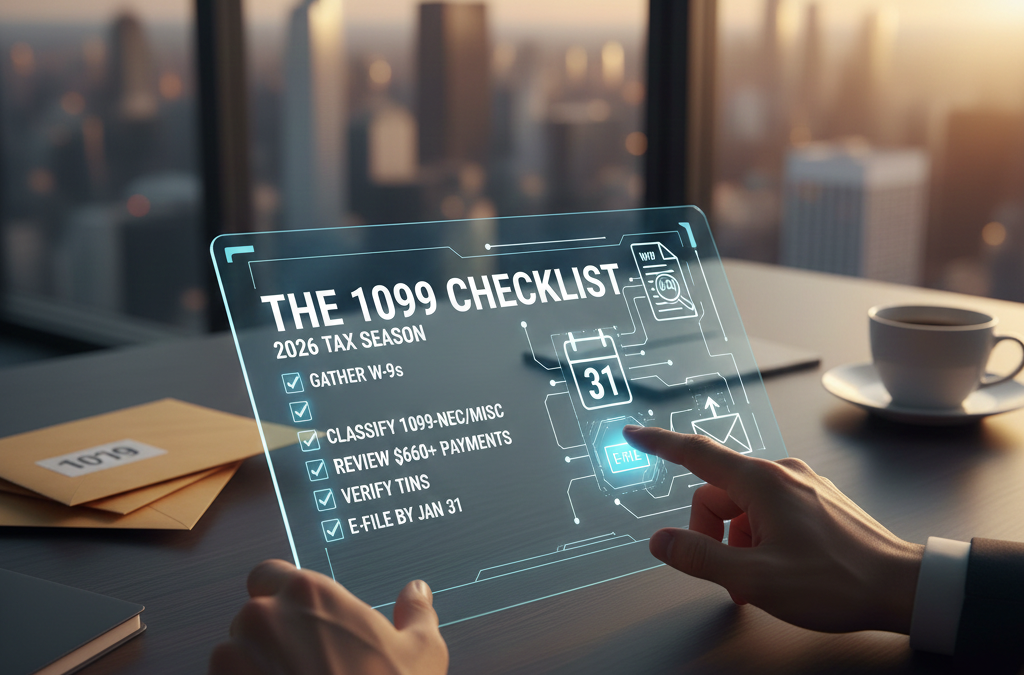
The 1099 Checklist: Everything You Need to Know for the 2026 Tax Season
The calendar has officially flipped to 2026, which means it’s time to shift focus from closing out last year’s books to preparing for the upcoming tax season. For many small businesses, a critical component of this preparation is the accurate and timely issuance of Form 1099. These forms report payments made to independent contractors, freelancers, and other nonemployee service providers throughout 2025.
Failing to comply with 1099 requirements can lead to penalties from the IRS and state tax authorities. This checklist is designed to guide you through everything you need to know to navigate the 2026 tax season confidently.
Actionable Summary: Your 2026 1099 Compliance Checklist
- Gather W-9s: Confirm you have a W-9 form for every vendor you paid over $600 in 2025. Chase down any missing forms immediately.
- Identify 1099-NEC vs. 1099-MISC: Correctly categorize payments. Most nonemployee compensation goes on Form 1099-NEC.
- Review Payments: Identify all vendors who received $600 or more in 2025 for services, rent, or other applicable payments.
- Confirm Vendor Information: Double-check TINs (Taxpayer Identification Numbers), names, and addresses against W-9s. Accuracy is paramount.
- E-File or Mail: Prepare your 1099s. Consider using accounting software or a third-party service for efficient e-filing.
- Meet Deadlines: Distribute recipient copies and file with the IRS (and states, if applicable) by January 31, 2026.
Deep Dive: Navigating 1099 Requirements for 2026
What is a 1099 and Who Needs One?
Form 1099 is an IRS information return used to report various types of income other than wages, salaries, and tips (reported on Form W-2). For small businesses, the most common type is the 1099-NEC (Nonemployee Compensation).
You generally need to issue a 1099 if:
You paid an unincorporated independent contractor, freelancer, consultant, or vendor (e.g., sole proprietor, LLC taxed as sole proprietor/partnership) for services rendered.
The total payment to this individual or entity was $600 or more in the calendar year 2025.
Payments were made in the course of your trade or business.
The Critical W-9: Your First Line of Defense
Before you even make a payment, you should request a Form W-9, Request for Taxpayer Identification Number and Certification, from every independent contractor or service provider.
What it provides: The W-9 provides the vendor’s legal name, business name (if applicable), address, and Taxpayer Identification Number (TIN), which can be an EIN (Employer Identification Number) or an SSN (Social Security Number).
Why it’s crucial: Without an accurate W-9, you cannot correctly fill out a 1099, potentially leading to backup withholding requirements or penalties. Collect W-9s before the first payment.
1099-NEC vs. 1099-MISC: The Key Distinction
Form 1099-NEC (Nonemployee Compensation): This is the form you will use for most independent contractors who perform services for your business. Think graphic designers, virtual assistants, consultants, plumbers, etc. This form was revived in 2020 specifically for this purpose.
Form 1099-MISC (Miscellaneous Information): This form is used for other types of payments, such as rents, awards, prizes, medical and healthcare payments, or fishing boat proceeds. Unless you’re paying a contractor for services, you’ll likely use this for other miscellaneous items.
Payment Types and Exemptions
What to include: Payments for services (including parts and materials if incidental to the service), rents (e.g., office space), legal settlements, and certain prizes/awards.
What NOT to include: Generally, payments to corporations (including LLCs taxed as S-corps or C-corps) are exempt from 1099-NEC reporting. Also, payments for merchandise, freight, or utilities are typically exempt. Payments made via third-party payment networks (like PayPal or Stripe) that report via Form 1099-K may be exempt from your 1099-NEC reporting, but verify IRS thresholds.
Important Deadlines for the 2026 Tax Season
January 31, 2026: This is the deadline to:
Furnish (mail or electronically provide) recipient copies of Form 1099-NEC and 1099-MISC to your contractors and vendors.
File Form 1099-NEC with the IRS (and relevant state tax departments, e.g., California’s FTB).
February 28, 2026 (Paper Filing): If you are paper-filing Form 1099-MISC, this is the deadline.
March 31, 2026 (E-Filing): This is the deadline for e-filing Form 1099-MISC.
Penalties: Late filing or incorrect information can incur penalties ranging from $60 to $310 per form, depending on the filing delay.
Proactive Steps for a Smooth 2026 Tax Season
Don’t wait until January 2026 to start this process.
Ongoing W-9 Collection: Make W-9 collection a mandatory step before processing the first payment to any new vendor.
Categorize Carefully: Ensure your accounting software correctly categorizes vendor payments (e.g., “independent contractor services” vs. “office supplies”).
Leverage Technology: Most modern accounting software (like QuickBooks Online) can generate 1099s for you. Many also offer integrated e-filing services.
Staying organized throughout the year and proactively addressing these items will save you significant time and stress when the deadlines hit.
“We’ve confidently referred businesses to them, and the feedback has been unanimously positive.”
– Mike Doherty: Founder, Understanding eCommerce.
Follow us on LinkedIn – Zumifi.