
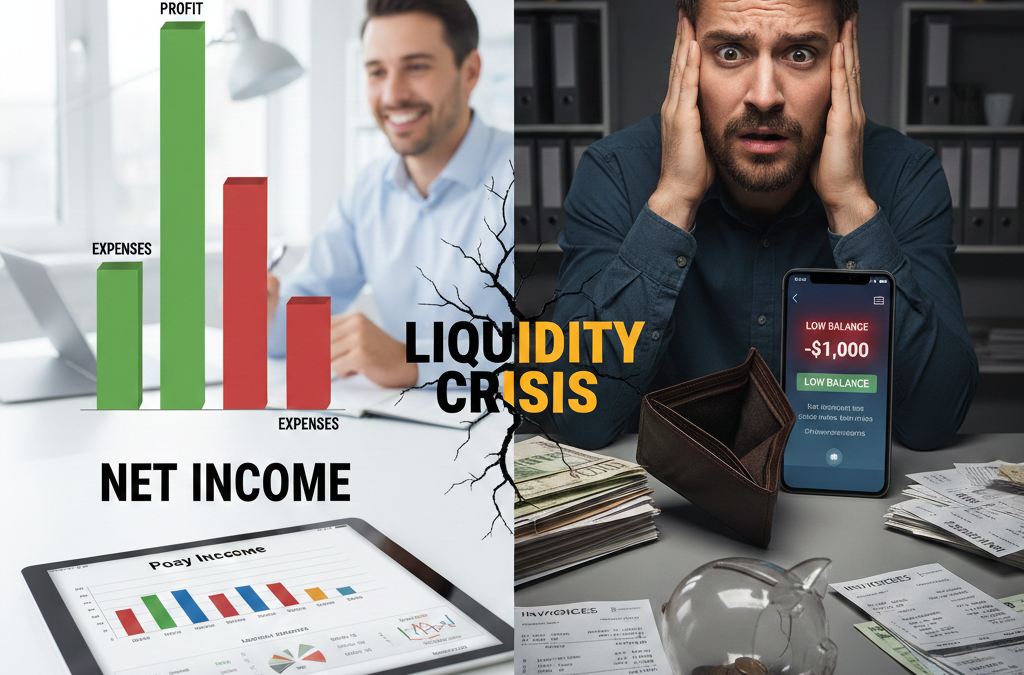
Profit vs. Cash Flow: Why You Can Be Profitable and Still Run Out of Money
It is the ultimate paradox of the business world: your dashboard shows a healthy net profit, your sales are hitting record highs, yet your bank account is hovering near zero. You’re profitable, but you’re broke.
To many new entrepreneurs, this feels like a mathematical impossibility. However, understanding the chasm between Profit and Cash Flow is the difference between a thriving enterprise and a bankruptcy filing.
The Fundamental Difference
At its simplest, profit is a theoretical accounting figure, while cash flow is a physical reality.
Profit (Net Income): This is what remains after you subtract your business expenses from your total revenue. It is recorded the moment a sale is made or an expense is incurred, regardless of when the money actually changes hands. This is known as accrual accounting.
Cash Flow: This is the actual movement of money into and out of your business. It is the “blood” in the veins of your company. If you have $10,000 in unpaid invoices from customers, your profit looks great, but your cash flow is zero until those customers actually pay.
Why the Gap Exists: Three Common Traps
How does a profitable company run out of cash? It usually boils down to three primary culprits:
- The Receivables Lag: You land a massive $50,000 contract. On your Profit & Loss statement, you just made a $50,000 sale. However, if your client has “Net 60” payment terms, you won’t see a dime of that money for two months. Meanwhile, you still have to pay your staff, your rent, and your suppliers today.
- Inventory Bloat: To make a profit, you have to sell inventory. But to have inventory to sell, you have to buy it first. If you spend $20,000 on stock that sits in a warehouse for six months, that $20,000 is “trapped.” It doesn’t count as an expense on your profit statement until the item is sold, but it’s already gone from your bank account.
- Debt Service and Capital Expenditures: Profit is calculated before certain “non-operating” cash outflows. For example, when you repay the principal on a business loan, that payment doesn’t reduce your profit—but it certainly reduces your cash. Similarly, buying a new delivery truck is a cash outflow today, but the “expense” is spread out over years through depreciation on your profit statement.
How to Protect Your Business
Monitor Your Cash Flow Statement: Don’t just look at your P&L. Review your Cash Flow Statement monthly to see where your money is actually going.
Shorten Your Receivables: Incentivize clients to pay early (e.g., a 2% discount for payments within 10 days) and be aggressive about following up on late invoices.
Manage Your Payables: Negotiate longer payment terms with your own suppliers. If you can get “Net 45” terms while your customers pay you in “Net 30,” you create a positive cash buffer.
Keep a Cash Reserve: Aim for 3–6 months of operating expenses in a liquid savings account to bridge the gap during slow payment cycles.
The Bottom Line
Profit is a measurement of viability, but cash flow is a measurement of survival. You can survive years without making a profit, but you won’t survive a single day without cash.
“We’ve confidently referred businesses to them, and the feedback has been unanimously positive.”
– Mike Doherty: Founder, Understanding eCommerce.
Follow us on LinkedIn – Zumifi.